
The book Thinking Fast and Slow was written by Daniel Kahneman and published in 2011. Its main topic is how our brain deals with information and forms thoughts.
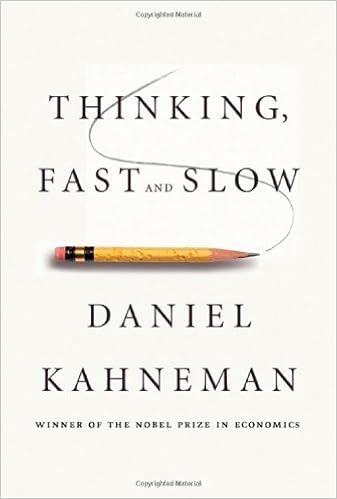
We have two modes of thinking, which Kahneman calls System 1 and System 2.
System 1 is where the thinking just “happens”, it is automatic and passive, and demands no effort. We have no conscious control over it, it is impulsive, rapid and we inherited it from our evolutionary past: there is a survival advantage to quick action or judgement. It is this way of thinking we use to solve easy mathematical problems such as 2 + 2, drive a car on an empty road, or feel disgust when reading the word “Vomit”.
System 2, on the other hand, demands much more effort, which is why it is less used, since we are lazy and have a limited capacity. It is deliberate, thoughtful and calculating. Thanks to it, we can control our impulses and solve complex mathematical problems. We can look for someone in a crowd based on given information, or drive a car in hazardous condition, as System 2 “wakes up” when things become unnatural. This phenomena can even be observed physically as pupils dilate when thinking hard.
We tend to make mistakes by using System 1 too often, thus answering questions without thinking, or by associating new information with existing patterns or thoughts, therefore creating biases. When we don’t know the answer to a question, System 1 will come up with an answer to a related question that is easier.
Those two systems have also been called Cognitive Ease and Cognitive Strain.

Another important idea in Thinking Fast and Slow has to do with intuition, and whether it should be trusted or not. As humans, we tend to follow our gut, acting impulsively and emotionally and therefore using System 1, when we rarely should. Anything repeated enough becomes familiar and safe, and we come to believe it is true, even though it isn’t necessarily the case. We see novelty as a potential threat. False intuition is real and indistinguishable from expert intuition; meaning we are confident we are right, when we aren’t.
We crave confidence and tend to trust people who appear that way, whether they are right or not, even if they are psychopaths and we’ve been warned against them.
Our behaviour is influenced by our environment, for example, we are much more likely to accept doing a surgery if we are told our survival rate is of 90%, rather than knowing that there is a 10% chance of us dying, even though those odds are exactly the same.
Similarly, we tend to be influenced by irrelevant numbers: if given a number, our answer will more likely be around that number, even if it obviously makes no sense retrospectively.
We also make decisions taking into consideration our losses and gains, with losses being much more important.
Our behaviour can also be influenced with design. Using a more legible typography, or images with higher contrasts will make us feel good and more likely to trust what we read, as our brain won’t have to work so hard. When seeing ads, we rarely use System 2. It is an important lesson to remember when creating new designs.
If you’d like to find out more, check out the links below:
Thinking Fast and Slow – Wikipedia
Thinking Fast and Slow – Animated Book Review
Daniel Kahneman: “Thinking, Fast and Slow” | Talks at Google
 My Journey in Web Design