
Last week in class we learned more about user empathy. For that we did a design thinking exercise: we watched a video featuring Ali describing what he liked and didn’t like about his wallet.
We were then asked to list 3 of those things, the ones that were “truly important to him”. Among many things the most notable ones were: needing to feel it in his pocket, the inside colour of it, the fact that it needs an ID holder. He also didn’t like the fact that it had stretched over time with the monstrous amount of cards and receipts he was stashing inside of it…
The next part of the exercise was to sketch a solution to this particular problem. We had a few minutes to come up with 4 different designs. I have to admit I wasn’t feeling particularly inspired and only came up with 3, none of them being mind blowing ideas, but at least feasible.
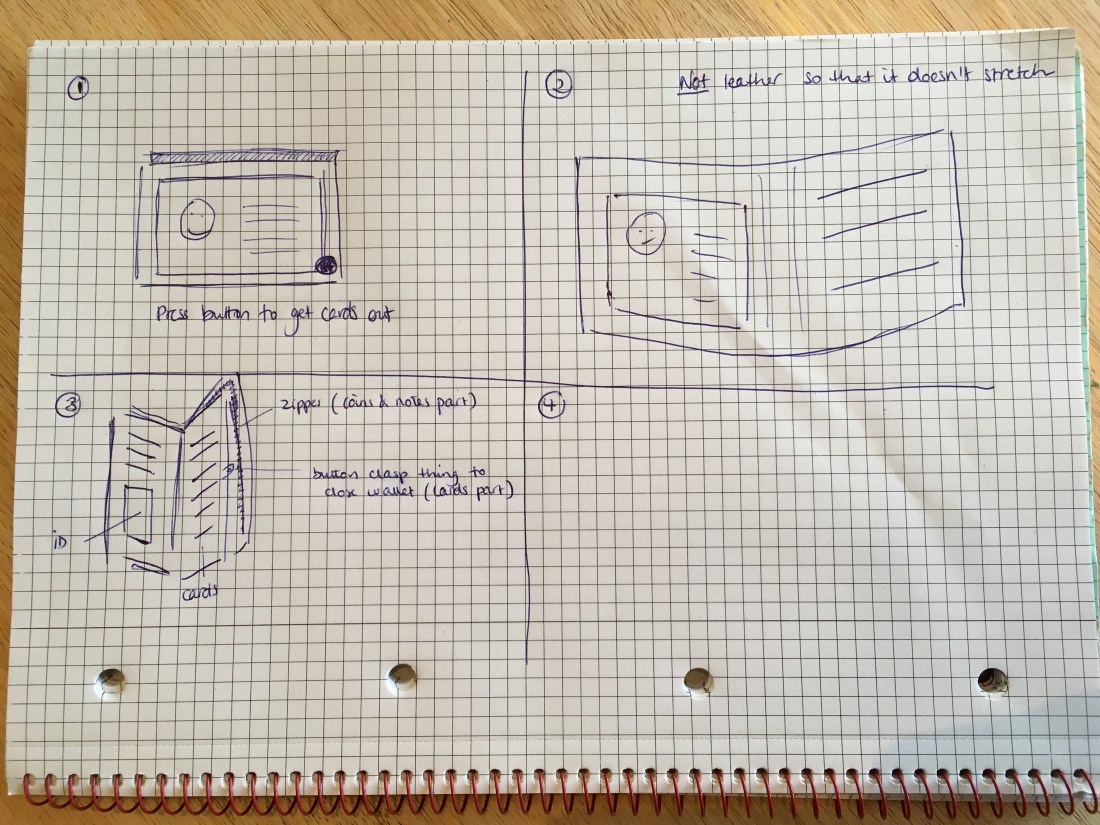
My first idea was a small wallet, pretty much the same size as a credit card. When you press a button, the cards inside come out. There’s only a limited amount of space in it, which would force him to think of which cards he actually needs/uses. The front of it is transparent, so he can put his ID in that spot without needing to take it out when he needs to show it.
My second idea was to use a material that doesn’t stretch, so to avoid leather. The design of the wallet itself is a very simple one, resembling Ali’s new wallet, once again with a part of it that is transparent and allows him to keep his ID there.
My third idea is actually a representation of my own wallet. One side of it contains all the cards, with a transparent side once again for the ID (unless you’re French and your ID is so big it won’t fit anywhere! Next YouTube video: Camille talking about her wallet experience). This side can be closed using some kind of button/clasp (I’m not sure how to explain it and I’m afraid looking at my drawing won’t help…). On the other side, you can put your coins and notes, and it closes with a zipper. You can also put a few receipts at the back of it.
After that, we had to pick the design we thought was the best, and explain the decisions we made when sketching.
Out of all my ideas, I would probably choose the sketch 3: the zipper and clasp avoid loosing important bits and if made using the right material, it shouldn’t stretch over time.
Some ideas in the class were quite similar to mine (zipper, elastic band, button to get the cards out), others a bit more original/far-fetched (a watch being used as a wallet, a scanning device attached to the wallet).
In conclusion, let’s just hope Ali’s new wallet won’t stretch again over time! Or that he will learn how not to be such a hoarder… But I guess we can’t change our users, just design according to their needs.
 My Journey in Web Design