
What is empathy? The definition given by the Oxford Dictionary is the following: “The ability to understand and share the feelings of another”.
This is a very important concept in human centered design, which is why, before designing anything, we must start by building empathy maps, which allow us to understand our users and their needs better.
There are a lot of different styles available out there; I chose to use one found on the Nielsen Norman Group website:
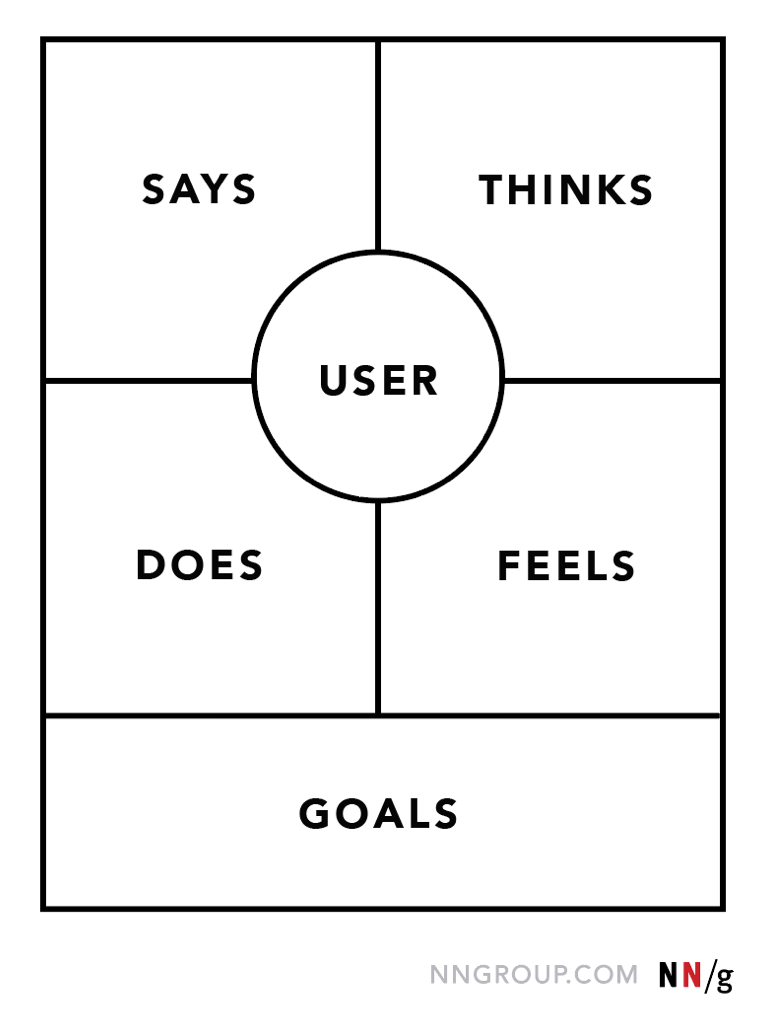
All of those maps, while having a different style, in the end have mostly the same features: find out what the user thinks, feels, does and says. You can also have their goals, or pains and gains. All 4 quadrants are slightly different, as what we feel isn’t necessarily what we think, say, or do. For this reason, it’s important to get in the user’s head, or to do tests and get them to tell you what they think and observe the rest.
As a class project, we had to find a UX problem on a company’s website, and offer solutions to it.
Ryanair, as we all know, allows you to book cheap holidays. This being what they’re known for, a lot of customers are looking for just that: go wherever it’s the cheapest. You would think one of their main features would be a search that allows you to pick a certain budget, and nothing else. As it turns out, they do have such option! It took me a while to find it, but I eventually did. The fact that this can’t be found straight away on their home page puzzles me.
Which is why I’ve decided that this is a problem that needs fixing. There will be a more detailed article on this problem later on. I hope you can handle the suspense.
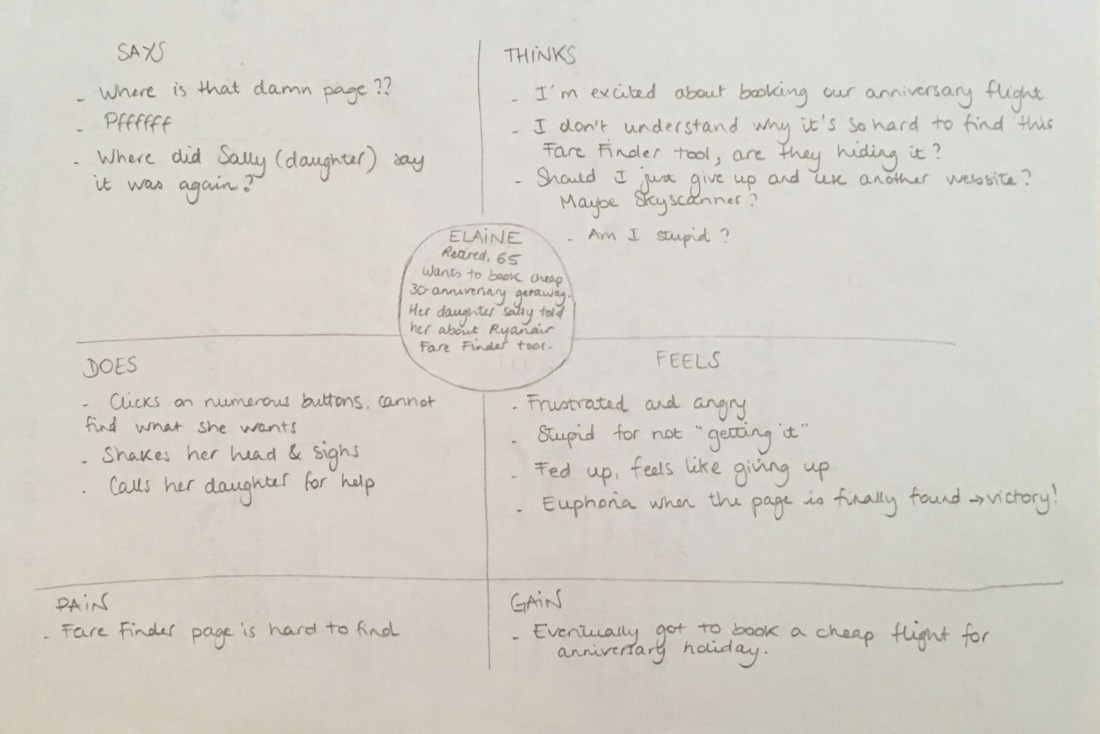
I have built two empathy maps on this subject, for two very different types of personas. The first one, Elaine, is a 65-year-old who’s retired. She wants to book a cheap getaway for her husband and herself to celebrate their upcoming 30-year-anniversary. Her daughter Sally has told her that she can use Ryanair’s Fare Finder tool as, since the destination doesn’t matter too much, she can just do a search based on her (rather tight) budget.
The second persona, Sébastien, is a 22-year-old art student who is constantly broke. He loves travelling though, anytime there’s a school holiday or a long weekend, you’ll find him on a plane. For that reason, he does not care about his destination, as long as it doesn’t cost him an arm and a leg. He’s been using Ryanair for a long time now, always having to enter a destination and fixed dates, and then scrolling and changing his options in order to find the cheapest one.
He’s just started wondering if there isn’t an easier way to do so, after all, Skyscanner allows you to book a flight without having a destination in mind.
Here is his empathy map, while begins his quest for the Holy Grail, aka Fare Finder, without being aware of its actual existence:
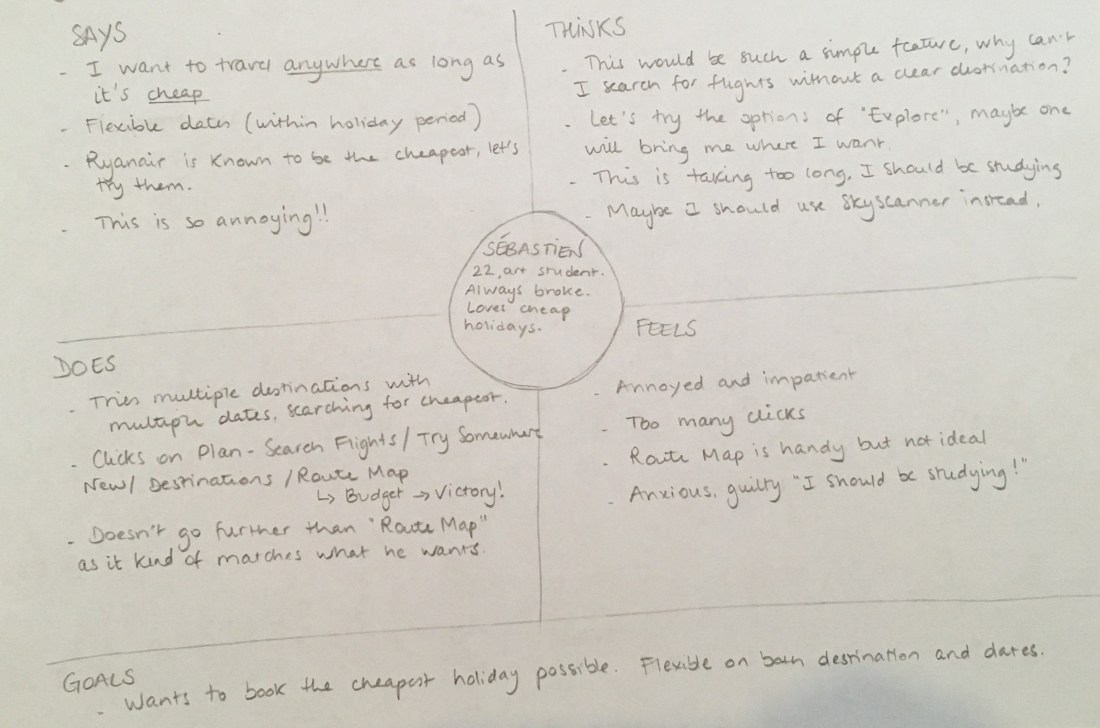
Both users are annoyed and frustrated that it took them so long finding the Fare Finder tool, which means they’re having a pretty bad experience on Ryanair’s website.
Both of them are considering using another website, such as Skyscanner, which is much more straightforward and easy to use.
Based on those empathy maps, those customers may not come back to Ryanair’s website (but we all know they will, we all do, no matter how many times we curse it!).
 My Journey in Web Design